
Over 150 Years Later

January is National Human Trafficking Awareness Month


“That on the first day of January, in the year of our Lord one thousand eight hundred and sixty-three, all persons held as slaves within any State or designated part of a State…shall be then, thenceforward, and forever free.”

In 1863 in the midst of the brutal Civil War, Abraham Lincoln proclaimed the freedom of 3.1 million slaves in the United States with the bold words of the Emancipation Proclamation.

A century and a half later, slavery is not effectively abolished in the United States, nor in any other nation of the world. An estimated 50 million people live in bondage worldwide. The United States is among the top three countries of origin of victims of human trafficking. Forced labor, sex trafficking, child marriage, organ trafficking—human trafficking comes in many forms, but in the end, it means the oppression and exploitation of another.

In 2010, as awareness of human trafficking grew, and the crime itself increasingly penetrated homes and U.S. neighborhoods, President Obama dedicated the month of January to raising awareness about trafficking and providing educational resources to the public, with the intent of leveraging the average civilian in the fight against modern slavery.

The month also brings attention to the governments, organizations, law enforcement, advocates, and other entities that provide a voice and resistance to trafficking.

Women At Risk, International (WAR, Int’l) proudly joins this civilian force, lending our hands, voice, hearts, and resources to liberating and protecting wounded and vulnerable women, men, and children. Joining with partners worldwide we reach out to those entrapped; we offer paths to hope, healing, and dignity to survivors; and we teach and train at-risk and rescued women, empowering them to provide for themselves and their families.

To give a glimpse into the scope of what we face, here are a few statistics:

· Human trafficking is estimated to be the third largest criminal enterprise in the world.

· Worldwide, forced labor generates an estimated $236 billion annually. Forced commercial sexual exploitation accounts for about $173 billion.

· In 2021, G20 countries imported $468 billion worth of goods potentially produced using modern slavery.

· Global challenges such as conflict, drought, disease, and climate change create significant risk factors for human trafficking.

· Sexual exploitation accounts for 79% of human trafficking.

· Almost 20% of trafficking victims worldwide are children.

Numbers such as these should not coexist with ignorance or apathy. While there are many organizations that exist to tackle one aspect or another of modern slavery, the need far, far outweighs the resources. What can one person do? Plenty. One person may not solve the global issue, but one person can change lives forever. So what can one person reading this blog do?

Start with one of these options:

· Take WAR, Int’l’s Civilian First Responder Training Course, online or in-person. These courses teach you how to recognize signs of trafficking in your community, how to respond to and report suspicious activity, how to create a circle of protection around the vulnerable, and how to spread awareness.

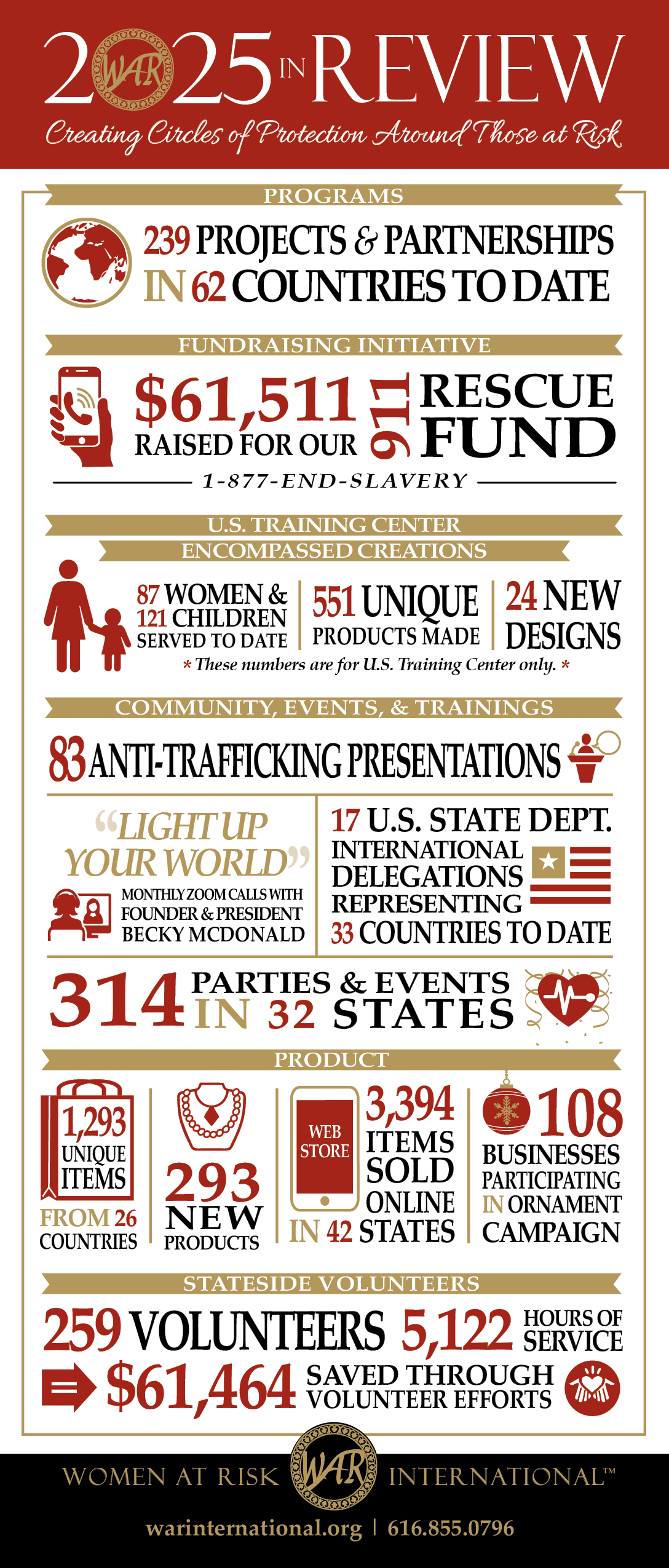
· Volunteer with WAR, Int’l. Last year volunteers donated 5,122 hours of service, allowing $61,464 to go back to the organization’s mission.

· Host a Shop with Purpose Boutique. $300 supports a woman in one of our international safehouses for one month. These boutiques are an important means of raising this money.

· Donate to WAR, Int’l, to a fund of your choosing or where it is needed most.

· Visit our website to find more ideas. There are many ways to get involved with WAR, Int’l in our fight against human trafficking, and our war for the precious lives at stake.

As she wrote in her journal watching the world as she knew it crumble under evil, and uncertain whether she would survive the dark time, Anne Frank wrote, “Look at how a single candle can both defy and define the darkness.”

The darkness is heavy, but you can be a light in your community. And, if you choose, the world.

USTC: United States Training Center


January, as National Human Trafficking Awareness Month, serves to not only encourage education and concern about the problem of trafficking, but to drive solutions and civilian involvement. It would be nice to think that once a woman is removed from the trafficking situation, rescue is complete. That is, however, far from being true. Trafficking leaves not only, in many cases, physical injury–but it creates deep mental and emotional chasms in the survivor.

To complete the rescue–to keep a woman from returning to a pattern of exploitation, as well as healing a wounded mentality–each woman needs to know she is worthy, capable, and ready to take on life as a whole person. To that end, Women At Risk, International (WAR, Int’l) operates the United States Training Center (USTC), combatting perhaps the most serious harm of the crime of trafficking–the theft of personhood–and creates new hope, new patterns, and new life.

What is the USTC?
The USTC is one of the most exciting manifestations of WAR, Int’l in our mission to educate, enable, and empower at-risk and trafficked women. The United States government estimates that, every year, over 300,000 minors are at risk of trafficking within the United States, not counting those trafficked into the United States from other countries. Located near WAR, Int’l’s global headquarters in Grand Rapids, Michigan, the USTC is a place where at-risk and rescued American women find meaningful employment and a means by which to rebuild their lives through artisanal work and meaningful support.

How did the USTC originate?
The USTC originated when the Grand Rapids headquarters of WAR, Int’l was only meant to be a home base for operating overseas missions. According to founder and president Rebecca McDonald, “we had women running in to escape their traffickers, and I couldn’t say that we care about this out in the world but not right here with [them]. We had to step into that space.” As a result, the vision for the USTC, a building where women could come to both feel safe and find safe employment, was born.

How does the USTC operate today?
Designed to give as much privacy and dignity to women as possible, the USTC is a multi-purpose space used to support and empower women. There is a kitchen, workshop space for the women employed by the USTC to practice their craft, and separate areas used by WAR, Int’l for a variety of events. Rebecca McDonald considers the USTC to be holy ground in the work that it does for at-risk and rescued women and frequently refers to it as a sacred space.

Women employed by the USTC have meaningful employment and are themselves artisans. Each of these designations has further reaching implications. Not only are they able to earn a living for themselves – and their children if they have them – but it becomes a point of pride that they are able to call themselves artisans and create beautiful pieces of wearable art. Furthermore, following their period of employment at the USTC, they have a legitimate entry on their resumes and acquired skills that they can apply toward their next place of employment.

What is Encompassed Creations?
Encompassed Creations is the brand under which all products at the USTC are created. The Encompassed Creations logo is a compass, with the directional letters at the points of the compass forming the following acronym from the brand’s tagline: Nurturing and Empowering Women toward Sustainability. A wide variety of products are made under this label at the USTC. In addition to jewelry – a significant proportion of the product generated by the women who work in the USTC – Encompassed Creations also includes candles, ornaments, the occasional trinket, and a spa line that includes hand-poured, cold-process soaps, body lotions, bath salts, face wash, and beard oil.

How can I get involved in the USTC’s vision?
There are a variety of ways in which you can promote and support the vision cast by the USTC: namely, you can uplift and support women as they reclaim their lives, livelihoods, and dignity. The best ways to support the artisans of the USTC are to shop their products, spread awareness, and encourage others to do the same.

Hosting a Shop with Purpose Boutique is a wonderful way to support the artisans of the USTC! A Shop with Purpose Boutique is an opportunity to bring the chance to buy USTC products in person to your community without traveling to our brick-and-mortar boutique location in Grand Rapids. WAR, Int’l does everything in its power to make hosting these boutiques – which spread awareness of the USTC’s mission in addition to supporting its artisans in the work of their hands – as easy as possible. For more information, or to sign up to host a boutique, click here.

It’s always been my dream…


Author: Liz, a survivor

Liz is a survivor of human sex trafficking. She was groomed and trafficked by a fake boyfriend in her teens. Thankfully, she escaped and is now married to a wonderful man, and they have 2 young boys.


In 2018, I started my clothing line Stolen Angels, Inc. One of my goals was to meet the Detroit Tigers and to partner with them or to be at their game to raise awareness. I wasn’t sure exactly why, but I knew I needed to connect with the Detroit Tigers (the baseball team of my childhood) and draw upon the influence they have in the community. I knew their influence was powerful and nobody was utilizing it. Plus, lots of MEN watch baseball, and I really wanted to reach men on the topic of human trafficking. Lots of trafficking can happen at sporting events (the Super Bowl, etc.) and I literally wanted to bring light smack dab in the middle of where it happens!

It’s always been my dream to be able to be at an actual game. Perhaps, even, one day to meet the team and let them know what a huge influence they have and the difference they are making. When I was doing my clothing line, I had rubber bracelets that had “Stolen Angels, anti-human trafficking advocate” on them. I emailed the community outreach for Detroit Tigers and asked if I could mail his team these bracelets for free. He said I could! So I mailed about forty bracelets to them, but then never heard anything more from them.

When I first heard Women At Risk, International (WAR, Int’l) representatives went to the field and the Tigers chose WAR, Int’l as their nonprofit for the July 12th game this year, I knew I had to be there! It was really awesome to be able to walk in those special doors with my wagon full of products made by rescued women. I almost felt as if I had the women sitting in the wagon with me and I was rolling them through the VIP entrance to have their work displayed for thousands to see.

I love working for an organization that thinks outside the box. Trafficking awareness shouldn’t be restricted to sitting behind a table at a flea market, but should be out in the community reaching the people, letting them know there is hope, there is help.

How will you get out in the community to share this message?

You never know, that woman that takes one of those flyers you’re handing out may be the next survivor that gets rescued because of YOU…

Learn about ways to get involved here.

Myths that Perpetuate Trafficking | Part Three


Myths that Perpetuate Trafficking (and Facts that Break Chains)

Part Three in a three-part series

Today, at least 50 million people are enslaved by the evil that is human trafficking. Though it is frequently punishable by law, the horrific realities are often hidden behind closed doors. To make matters worse, the shadowy nature of human trafficking contributes to many misunderstandings which allow the industry to thrive. In the spirit of National Human Trafficking Prevention Month, here are a few myths that confuse and hinder the efforts to combat human trafficking in our own communities, nationally, and across the globe.

It is of note that this is not an exhaustive list.

***

Myth: There’s nothing you individually can do about trafficking.

Fact: There are many actions you can take as an individual within a community to reduce the risk of trafficking and the number of people being trafficked. Educating your community on tell-tale signs of trafficking and where trafficking risks abound is incredibly important. Women At Risk, International provides a number of resources to help individuals combat trafficking, including a tip hotline and materials on how to recognize the signs of trafficking, who to contact if you recognize areas of concern, and how to build relationships and trust in order to build and maintain circles of protection within those communities.

Myth: Most victims are kidnapped or forced into sex trafficking.

Fact: One of three trafficking victims are runaways, but only three percent of trafficking victims are kidnapped as part of their induction into the industry. Over ninety percent of victims know or are in community with their traffickers, and traffickers frequently trick their victims into the sex trade by offering them better jobs or more consistent work. More recently, traffickers are using older “cool” girls at school to recruit younger girls into sex slavery. This can take a number of forms, but it is particularly important for parents to know where their children are and to make sure their children know that they (the parents) will give them a ride home at any time.

Myth: Only pretty girls are trafficked or only poor girls are trafficked.

Fact: Anyone can become a victim of trafficking. Traffickers are experienced at targeting marginalized youth and will go after anyone who they think will be an easy target. Targeting of vulnerable youth has been on the rise in recent years, as has targeting of physically and mentally challenged youth or adults. To give an example of the latter, if a girl has the body of an eighteen-year-old but the mind of a five-year-old, she’s incredibly vulnerable. Poverty is certainly an at-risk demographic, but the flip side is that materialism in upper-middle-class families can be a powerful lever in endangering girls in those families who want luxury items but can’t or don’t want to put in the hours necessary to earn them.

Myth: You don’t need to explain the dangers of trafficking to protect your children.
Fact: Failing to explain risks and signs that put them at risk endangers children and reduces their ability to be aware and protect themselves. Keeping them in the dark may “keep them innocent,” but in the words of one survivor, her parents’ silence ultimately made her more stupid than innocent. In the age of the internet, children will receive messaging about sex and sexuality far earlier than they should, and it is on parents to ensure that their children’s first education comes from them, rather than less reputable sources. Informing your children also enables them to know what the risk factors in their friends’ lives are, expanding the circle of protection to include even more of the community.

Join us in facing the reality and breaking the chains of modern slavery!

Attend a Civilian First Responder Training Conference to learn how you can rise up against trafficking.

Host a pop-up boutique to educate your community and support survivors on their healing journeys.

Read Part One in the series here.

Read Part Two in the series here.

From the Desk of the Founder: Juneteenth


From the desk of Rebecca McDonald, founder & president of Women At Risk, International (WAR, Int’l):

WAR, Int’l and our nation observe Juneteenth to celebrate the end of legal slavery in our great nation. Brother took up weapons under Abraham Lincoln’s direction against brother. In fact, my husband’s family did just that. A northern soldier took up arms against a southern brother. Years ago, we took a Bengali man to see Gettysburg. He was stunned that brothers fought brothers for those neither was related to. In Islam and Asia, families disagree, but for a family to fight family for non-family was stunning. It was interesting to see our civil war through his eyes.

Juneteenth is a powerful reminder of how far our nation has come.

That is the good news….now the bad news. Today, we still have staggering illegal slavery. We got rid of legal slavery. We did not get rid of racism. We still have a long way to go on that. But today we have an illegal slavery, human trafficking, that is the fastest growing crime in our nation. Our children, minors, are the primary target, with the government estimating (pre-2020) that we have up to 300,000 American minors (not over 18…not foreigners in this count) at risk annually. These are your daughters and sons, my grandbabies, with constitutional rights. Yet, we rarely talk about this.

So, this Juneteenth, I personally am calling for both a Lament and a Hope.

We are called to “rejoice with those who rejoice” and “mourn with those who mourn.” Juneteenth invites us to do both. Lament is not despair. It is a form of prayer against injustice. We are called to honestly grieve the staggering evil of slavery and its lasting impact. We lament the reality that the promise of freedom was and is destroyed for so many. We bring this sorrow to mind, heart, meditation, and prayer. We acknowledge the brokenness of both the past and the present.

Lament and Hope lead to action and a path to unity.

Holding both Lament and Hope moves us to act. It is a call looking back to listen to the stories of our Black brothers and sisters, to see if we need to repent of our own biases we may not even be aware of, and to actively build bridges of understanding that reflect a heart of love. Our Hope is anchored in the character of a good God who delivered His people from Egypt, proclaiming freedom.

On Juneteenth, we celebrate the incredible faith and resilience of those who endured.

We find hope in the truth that the broken can find healing. To practice Lament and Hope, we commit to pursue justice, love mercy, and walk humbly to set captives free. WAR, Int’l openly celebrates freedom and quietly salutes the thousands of men, women, and children who find freedom through our efforts and those of our partners. Their stories of rescue are sacred and confidential. We have set free those as young as three-weeks-old, one-month-old, seventeen-years-old, and countless others set free to heal, hope, and rebuild their lives one day at a time in their own way and with a circle of protection around them.

This Juneteenth, I embrace both the grief of lament and the joy of hope.